

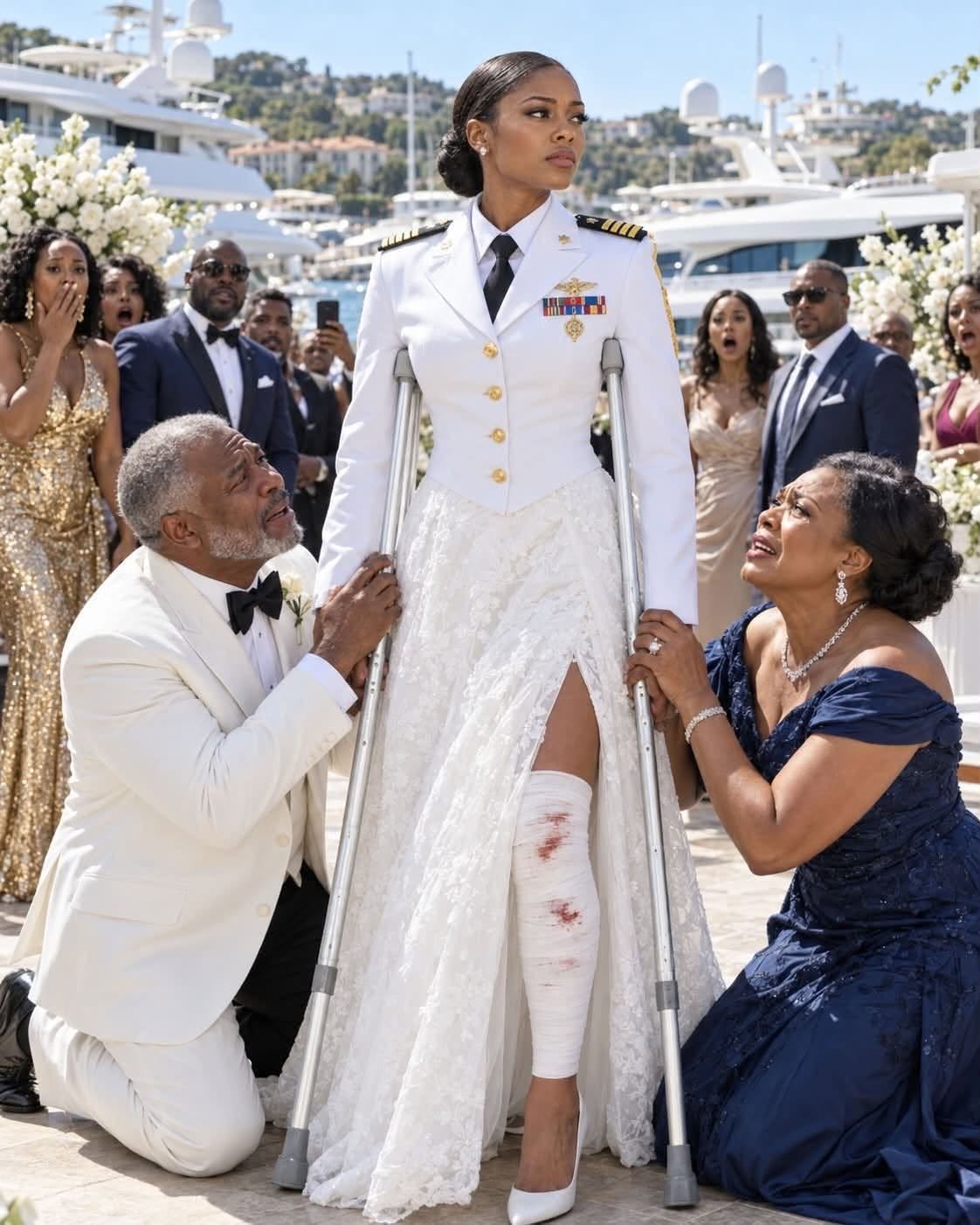
My parents bought my sister a hundred-and-fifty-thousand-dollar yacht the same week a military doctor told me I had until Thursday to save my knee, and when I asked them for five thousand dollars my sister told me to stop k*lling the vibe of her party.
My twenty-year-old brother sold our grandfather's tools and brought me eight hundred and forty dollars and a lottery ticket. The ticket was worth two point four million. The thing that actually ended my family was worth more, and it had been sitting in a filing cabinet with my name on it since I was nineteen.
PART 1
I was still in my fatigues when my father answered the phone.
My knee was swollen beneath a heavy brace, my hands gripping the edge of the exam table inside a military clinic.
The doctor had just finished explaining that if I didn't get private surgery by Thursday, the damage could become permanent.
Permanent.
That word kept echoing in my skull.
"Dad," I whispered, fighting to keep my voice steady, "the doctor says I need surgery.
It's five thousand dollars.
I wouldn't ask if it wasn't serious."
For a moment, all I heard was noise in the background.
Music.
Laughter.
Then champagne popped.
My father sighed like I had interrupted something important.
"Imara, this is really bad timing.
We just closed on Danica's yacht."
I stared at the white clinic wall.
"A yacht?"
My mother laughed somewhere behind him.
"Tell her not to be dramatic!"
Then my sister grabbed the phone.
"Imara, seriously?" Danica snapped.
"Can you stop k*lling the vibe of my party?
Take some Advil or something."
Something inside me went completely still.
I had served eight years.
I had pushed through pain and exhaustion without complaint, because that is the job and because complaining was never a thing my family permitted me.
But to my own parents, my leg was worth less than a champagne toast on my sister's new toy.
I hung up without saying goodbye.
Two days later, someone knocked on my apartment door.
When I opened it, my little brother Theo stood there with grease still under his fingernails and red-rimmed eyes.
He was only twenty, but he looked like the world had aged him overnight.
"I'm sorry," he said, pressing a folded stack of cash into my hand.
"It's only $840."
My throat tightened.
"Theo… where did you get this?"
His mouth trembled.
"I sold Grandpa's tools."
I couldn't speak.
Those tools weren't just metal and handles.
Grandpa had left them to him, and Theo had planned to use them one day to open his own garage.
He had sold his future so I might still have mine.
Then he placed a crumpled lottery ticket on top of the money.
"I bought this with the change," he whispered.
"Maybe God owes us one miracle."
I wanted to break down right there.
But the next morning, when I checked the numbers, I didn't cry.
I didn't scream.
I couldn't even breathe.
Every number matched.
$2.4 million.
For a long time I just sat there staring at the ticket while Theo slept on my couch, exhausted from worry.
I didn't call my parents.
I didn't call Danica.
I didn't celebrate.
I put on my brace, grabbed my crutches, and walked into one of the most expensive law firms downtown.
The attorney glanced at my worn jacket, then at the lottery ticket I slid across his desk.
"I want this claimed anonymously," I said.
"And I want a forensic investigation into my parents' finances."
His eyes sharpened.
"You understand what you're asking?"
I leaned forward.
"It means war."
He studied me carefully.
"Against your own family?"
I thought of Danica laughing while I begged.
My mother sipping champagne while calling me dramatic.
My father deciding my leg wasn't worth five thousand dollars.
Then I thought of Theo selling Grandpa's tools with tears in his eyes.
"Yes," I said.
"Dig until you find everything."
The attorney slowly opened a file.
Then his phone rang.
He listened for three seconds.
His face changed.
"Ms. Whitfield," he said quietly, "I have to stop you, and then I have to tell you exactly one thing and ask you to leave, and I want you to understand that the second part is the favor."
"What?"
"That was our conflicts desk.
This firm cannot represent you, because this firm represents Whitfield Marine."
"I've never heard of Whitfield Marine."
He looked at me for a long moment.
"Ma'am," he said, "you own nineteen percent of it."
PART 2
My grandfather was Curtis Whitfield.
He ran a marine repair yard on the south end of the harbor for forty-one years — engines, hulls, the unglamorous half of a glamorous industry — and when he d*ed I was nineteen years old and eleven weeks into basic training, and I did not come home for the funeral because I could not, and my mother told me on the phone that he had left "some tools to Theo and a few sentimental things."
That was the entire accounting I received.
Here is the actual will, which I read for the first time at twenty-eight, in a public records office, for eleven dollars.
Whitfield Marine Services, Inc., divided as follows.
Forty-three percent to his son, Cyrus — my father.
Nineteen percent to Imara.
Nineteen percent to Theodore.
Nineteen percent to Danica.
Equal shares to the three grandchildren, and the tools to Theo by name, because my grandfather knew exactly which of his grandchildren had spent his last four summers in that yard with him and it was the boy who was eleven.
My parents never told me.
