

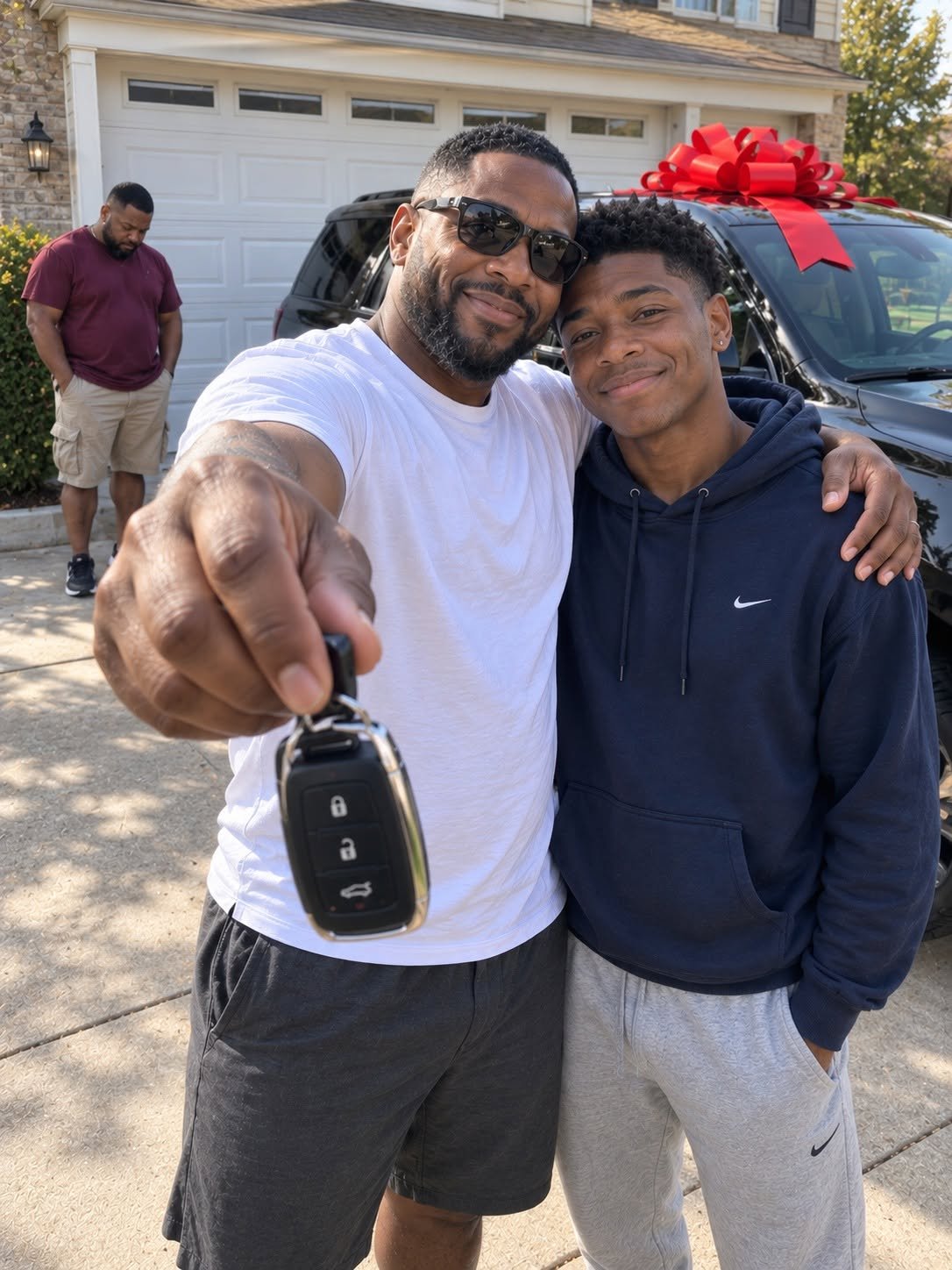
I did not refuse the car.
Refusing it would have been a scene, and Wade was extremely good at scenes. He would have driven home with a story about an ungrateful kid and he would have told it for a decade and it would have worked.
And I did not say "it's yours, Hollis," because it wasn't, and everybody in that driveway would have known it wasn't.
I gave him the authority.
Which is the one thing Wade had come for.
He had not come to give me a car. He had come to be the man who decides. And I took that, on a driveway, at seventeen, and handed it to somebody else in front of him.
And Wade laughed.
He did. He stood there and laughed, and he said: "All right. That's a new one."
And then he said to my mother — not to me — "Let me know when he grows up."
And he got in his hire car and went.
Ollie was eleven and he asked me about four times that night whether I was going to be allowed to drive it.
And I want to describe the next four minutes, because everybody who hears this assumes the driveway emptied straight away and it did not.
Nobody moved for a bit.
My mother had a tea towel in her hand. She had come out with a tea towel because she had been doing the dishes when the doorbell went, and she stood there holding it for the whole of it.
Maisie was nine and she was sitting on the porch step with a paper plate.
And Wade did the thing that men like that do when a room has gone against them, which is get louder and friendlier.
He clapped his hands once and said, "Right! Who wants a look?" — at nobody, at the driveway generally — and he opened the driver's door and put the seat back and started telling Ollie about the engine.
For about ninety seconds that man gave a tour of a car to an eleven-year-old who did not know what was happening.
And Hollis stood next to me the whole time with a set of keys in his fist and did not say one word.
And then Wade shut the door and the tour was over because there was nobody left to give it to, and that was when he said the thing to my mother about letting him know when I grew up.
It was the only genuinely unbearable part of that afternoon and it lasted a minute and a half and nobody has ever mentioned it since.
And that is the end of the part everybody likes.
I felt about ten feet tall for roughly nine days.
And then that car started costing money.
A brand-new car, insured for a seventeen-year-old, in his own name, in October of 2013.
Four thousand one hundred dollars for the first year.
And I did not know that number at the time. I did not think about insurance once. I was seventeen and somebody had put a car on my driveway and the word insurance did not enter my head for one second.
Wade never paid it.
He was never going to. It never came up. There was no argument about it and no broken promise, because nobody ever asked him, because everybody in that house knew there was no point.
Hollis paid it.
Four thousand one hundred dollars in the first year and three thousand eight hundred in the second.
Eight thousand nine hundred dollars.
And he took it out of the college account.
All of it — the three thousand four hundred that was in there by that October, which was fourteen months of whatever was left at the end of the month — and then everything on top of it.
And he took a Saturday job at a builders' merchant in the January of 2014 and kept it until I left, and he told my mother it was because he was bored at weekends.
And there were two things about that car in those two years that I did notice and did not think about, and I want them in, because I was not blind. I was seventeen, which is different.
One. I never got a bill for anything.
Not the insurance, not the tax, not the service in the March of 2015 that cost four hundred and eleven dollars.
A brand-new car in my name for two years and I never once opened an envelope about it.
And I remember, vaguely, understanding that Hollis "sorted" it, in the way you understand at seventeen that the boiler gets sorted.
Two. The Saturday job.
He started it in the January of 2014 and he told me — and he looked at me while he said it — that he was bored at weekends.
And I was seventeen and a man told me he had taken a Saturday job because he was bored, and I thought: fair enough.
A fifty-year-old man with two kids every other weekend and a stepson and a full-time job, bored, taking on Saturdays at a builders' merchant, in the January, for the company.
I did not question it for one second, for two and a half years.
And I did not know any of this.
Not for thirteen years.
I went to college in 2016 on a loan I am still paying, and I have spent my entire adult life believing there had never been much in that account.
Which is exactly what he let me believe.
And the chemistry, which I have mentioned in one line and which deserves more, because it is the whole man in one evening.
I was sixteen and I was failing it and I had decided to drop it.
And he did not know any chemistry. None. He left school at sixteen and he fits kitchens.
So what he actually did, for about five weeks, was sit opposite me and make me read it out loud to him.
That is it. That is the entire method.
He would say "what's that one mean" and I would have to explain it to a man who could not check whether I was right, and about half the time I would get four sentences in and hear myself and go: oh.
And he never once pretended to follow it. He never nodded along. If I said something and he did not get it he said "no, I've lost you," and I would have to go back.
I got a B.
And at some point in about the March my mother told me he had been reading the textbook on his own in the evenings after I went up, and getting nowhere with it, and doing it anyway.
She told me that one too.
How I found out.
I am thirty and I bought a house in the spring.
And there is a point in that process where somebody asks you for documents you have not thought about since you were a teenager, and I rang my mother and asked whether she still had my old paperwork.
She has a folder. She has had it since about 2011 and it is held together with an elastic band.
And she gave me the whole thing and I went through it at my kitchen table on a Sunday.
And about two thirds of the way down there are two insurance certificates.
October 2013 and October 2014.
Policyholder: my name.
Payer: Hollis Brandt.
And I sat there and looked at them for a while, and then I rang my mother, and she told me the rest of it in about four minutes without pausing, because she has clearly been waiting thirteen years to be asked.
The account. The Saturdays. The builders' merchant.
And she said — and this is the sentence that took the legs out from under me —
"He asked me not to tell you. Same as with the account."
Same as with the account.
He never told me about the money going in and he never told me about the money going out, and my mother has carried both halves of that for thirteen years, and she told me both of them the same way: quietly, on the phone, when I was old enough to ask.
And the two insurance certificates themselves, which I still have and which are the plainest documents I have ever been destroyed by.
They are A4. They are computer-printed. One is slightly yellow along the top edge where it has sat in an elastic band for a decade.
There is nothing on either of them except a policy number, a registration, a vehicle description, my name under POLICYHOLDER, his name under PAYER, and a figure.
No note. No message. Nothing written on the back.
And I keep going back to the fact that he filed them.
He did not throw them out. He gave them to my mother and she put them in the folder with my birth certificate and my exam results and a photograph of me at about four.
Which means that at some level that man expected somebody to look at them one day.
Not necessarily me. But somebody, at some point, going through the paperwork of a life.
Eight thousand nine hundred dollars and two and a half years of Saturdays, and the only record he left of it is two receipts in an elastic band, filed where they belonged, with his name in the wrong box.
And now the part I have had to sit with, which is what that driveway actually was.
I was seventeen and I did a thing that felt like loyalty.
And it was. I am not going to pretend it wasn't.
But what I actually did on the fourteenth of October, 2013, was hand a man who was already paying support for two kids a brand-new car and full responsibility for it, in front of everybody, and then go inside and eat a cake.
I made him the custodian.
That is the exact word I have been using about it for thirteen years, with a certain amount of pride.
Custodian of an eight-thousand-nine-hundred-dollar liability that I never once asked about.
Wade put that car on the driveway to humiliate him.
And I made sure it worked.
Not how Wade intended, and not in front of anybody, and Hollis Brandt has never once given the slightest sign of having noticed it that way. But he wrote a cheque every October for two years because a seventeen-year-old handed him a set of keys and said something that sounded good.
And there is a week in the middle of all this that I have not mentioned, which is the week I did not ring anybody.
Between the Sunday I found the certificates and the Sunday I went to their house, there were seven days.
And what I did in those seven days was work out how to make it not be true.
I went back through the folder twice looking for something that would show Wade had reimbursed him. I checked whether the policy could have been a fleet thing through Hollis's work. I looked up whether a stepparent has to be named as payer on a minor's policy for some technical reason, which is not a thing, and which I spent about forty minutes on.
I was thirty years old at a kitchen table trying to find a version of the facts where nobody had given up anything for me.
Because the alternative was that the best thing I ever did — the driveway, the keys, the sentence — had cost the man it was supposed to honour eight thousand nine hundred dollars and two and a half years of Saturdays.
And it took me a week to stop looking for a way out of that, and I have not entirely stopped.
What I did about it.
I tried to give him the money, obviously.
In the May, at his kitchen table, with a figure written down because I could not say it out loud.
Eight thousand nine hundred, plus the three thousand four that was in the account, which I had decided to count because it was mine and it went on that car.
Twelve thousand three hundred dollars.
And he looked at the piece of paper and he pushed it back across the table and he said: "No."
And I said I was going to keep asking.
And he said: "You can keep asking."
And we did that four times between the May and the August, and on the fourth one he got properly annoyed with me, which I have seen that man do about three times in fourteen years.
He said: "Gus. If I take that, then it was a loan. It wasn't a loan."
And then: "It was mine to spend and I spent it. That's the end of it."
So I stopped asking.
And then I did the only other thing available, which I stole from him.
Maisie has a daughter.
She is two. Maisie is twenty-two and she did not go to college, and I am not going to write the reasons down because they are hers, and money was one of about four of them.
In the September I opened an account.
I put in whatever is left at the end of the month. Some months that is four hundred dollars. In November it was sixty.
And I have not told Maisie and I have not told Hollis and I am not going to.
My mother knows, because I needed somebody to know in case anything happens to me.
Which is, as far as I can tell, exactly how this works.
And the fourth argument, in the August, which is the only time I have ever seen that man properly angry.
I had got clever by then.
I had stopped offering him money and started offering him things. A van — his is a 2011 and the sills are going. A holiday. Paying off the last of something.
And in the August I found out he had been quoted for a new boiler and had not gone ahead, and I rang the firm and asked what it would cost to just have it done.
And I told him I had done it, at his own table, pleased with myself.
And he put his mug down and said: "Cancel it."
And I started to say something and he said it again, and then he said the thing I think about most.
"You're doing exactly what he did."
And I said that was not fair.
And he said: "I know it's not the same. I know why you're doing it. But you're standing in my kitchen telling me what you've bought me, and I didn't ask, and I've said no four times now."
"Turning up with a thing is not the same as asking somebody what they want."
And he was right, and I cancelled it, and we did not speak for about nine days, which is the longest we have ever gone.
And in the November he rang me and asked whether I could give him a hand moving a wardrobe.
Which is how that man ends an argument and always has been.
The other people in it.
Wade Ferris is fifty-nine. He rang me in 2019 about something and we spoke for about eleven minutes and it was fine and nothing came of it.
He does not know any of what is in this document. He does not know the car cost anybody anything. He does not know there was an account.
As far as that man understands his own life, he bought his son a car in 2013 and was insufficiently thanked for it, and I would put money on him having told that story at least forty times.
And I have thought a great deal about whether to tell him.
And I am not going to, and the reason is not that I am above it.
It is that telling him would be about me. There is no version of that phone call that helps Hollis Brandt. It is just me wanting a man to know he was beaten, thirteen years later, by somebody who did not tell him at the time.
Ollie is twenty-four and he is a plumber and he is better company than any of us.
My mother and Hollis are still married and she is fifty-four and he is fifty-seven, and she told me in the August that the Saturday job was the only thing they ever properly argued about, because she worked out what it was for in about three weeks and he would not discuss it.
And the car.
It went in 2016, when I left. Sold for about nine thousand, which went straight back into the account it had come out of, and which is what I used for my first year's books and a deposit on a flat in 2019.
So I did get it in the end. It just went the long way round and through a man who is not my father.
And Maisie, because the account I opened in the September is for her daughter and she does not know, and that sits slightly wrong with me.
She was nine on that driveway with a paper plate.
And she is the one out of all of us who got the least, and nobody planned that and nobody noticed it while it was happening.
Ollie got a trade. I got a loan and a degree and a house. And Maisie was eleven when I left for college and sixteen when Hollis's overtime finally stopped, and by the time it was her turn to be the expensive one there was nothing left in the middle of that family to be spent.
I did not take it off her. There was never a pot with both our names on it.
But there was a Saturday job that ran from 2014 to 2016, and eight thousand nine hundred dollars, and a man who only has so many Saturdays in him.
And she has never said one word about any of it, and I do not think it has ever occurred to her, and I am not going to be the person who puts it in her head.
Which is why the account is quiet, and why I told my mother and nobody else, and why I am aware that I have now invented a reason to keep a secret from somebody for their own good.
Which is the family business, apparently.
And the last thing, which is the keys.
He kept them.
Thirteen years, on his own keyring, with his house key and his van key and a fob for a gym he has not been to since 2018.
A car key for a car that was sold in 2016 to somebody in the next county.
And I never asked for them back.
I said "I'll ask you when I want them" on that driveway at seventeen years old, and then I went to college and got a job and got a flat and bought a house, and I never asked, not once, for thirteen years.
Because I did not want them. I had made a gesture with them and the gesture was finished and the keys were just keys.
And in the September, after the folder and the phone call and the four arguments about the money, I asked him.
In his kitchen. I said: "Can I have my keys."
